Anatomy of custom business software: what really makes it useful
Pubblicato il 15 dicembre 2025 · 13 min di lettura
"What's actually inside a well-built custom system, which parts are worth the effort, and which ones are usually overrated. A concrete guide to understanding where the real value is."
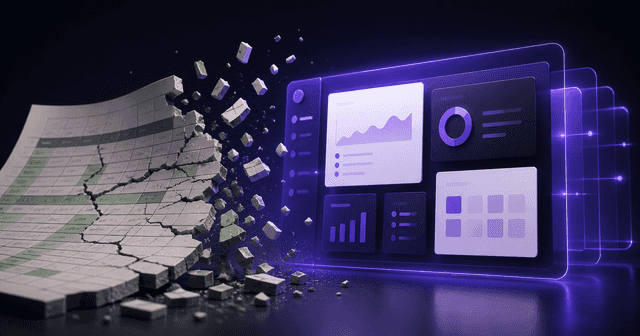
Italian SMBs often talk about "custom business software" as if it were a single, well-defined object, identical for everyone. In reality, the term covers very different products — from a 5,000-euro system that does one thing, to a project worth hundreds of thousands that orchestrates a company's entire operation.
When approaching the decision to build one (or have one built), understanding what it's made of helps enormously. It helps choose the right developer, avoid spending on parts that don't matter, recognise whether what's being pitched is solid or just a façade.
This article is an honest anatomy: what's inside a well-built custom system, which parts are really worth the effort, and which ones cost a lot and bring little.
The fundamental difference: custom system vs vertical software
Before getting to the what, one point that creates confusion is worth clarifying. A "business system" can be:
- An off-the-shelf vertical software already designed for a sector (e.g. for gyms, restaurants, medical practices). You configure it, you don't develop it.
- Custom software, meaning a system built specifically for your company, on your real processes, without compromises forced by other clients.
When this article talks about "custom-built" we mean the second. The first is a different choice that makes sense when your sector is standard enough to have a decent solution already.
Custom is for when your way of working has specifics no off-the-shelf software covers well. It's more expensive, it's more powerful, but only if it's actually what you need.
The pieces that make it really useful
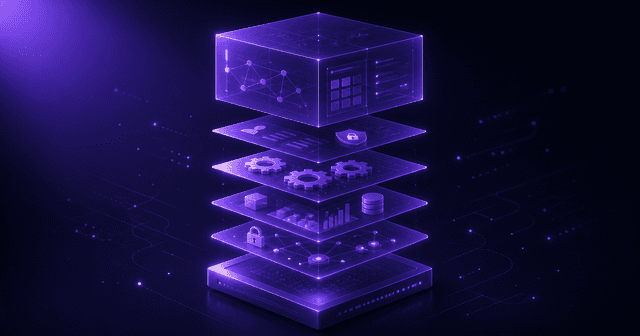
A well-built custom system is composed of layers that all need to be built, even if they aren't visible the same way.
1. Domain modelling
It's the invisible piece that decides everything. Meaning: how are your business entities represented inside the system? What is a customer, what is a project, what is an order, what is an item, how do they connect, what states can they have?
A system built on solid domain modelling is elastic: new requirements can be added without tearing it down. One built on bad modelling — done in a hurry, "we'll figure it out as we go" — gets stuck within six months and every new request becomes expensive.
Concrete signal to ask for: "How much time do you spend on modelling before writing code?" If the answer is "little" or "none, we just start" — alarm bell.
2. Authentication and roles
It sounds like a boring feature, but it's one of the most strategic. Who can see what, who can modify what, who can approve what. In a serious system, roles must be granular: not just "admin / user," but "production manager who sees their own departments," "salesperson who only sees their own clients," "admin who invoices but doesn't see margins."
Without granular roles, the system becomes either "everyone sees everything" (a reputation and compliance problem) or "nobody sees anything useful" (an unused system).
3. Unified records management
The heart of any management system is its records: customers, suppliers, products, employees. The most underrated thing is that these records have to be unique: a customer exists once, with a stable ID, and the entire system rests on it.
When records are "soft" — duplicates allowed, codes reassignable, data different module by module — the system looks tidy at first and becomes a mess over time. A good custom system doesn't allow duplicates, handles merges when needed, keeps history.
4. Operational flows
The most visible piece for people using the system. Meaning: how an order is created, how it moves to the next state, who gets notified, what happens if data is missing, how exceptions are handled.
A good operational flow:
- Is guided (the user always understands what to do next)
- Has controls (prevents inconsistent states)
- Allows controlled exceptions (someone with authority can skip a step with justification)
- Has a visible history (who did what, when)
Mediocre custom systems skip the fourth characteristic, and that gets paid every time you have to investigate a problem.
5. The document layer
Standard documents: quotes, orders, delivery notes, invoices, certificates, reports. A good custom system doesn't force you to leave it to produce them: it generates them directly, with the data already in place, formatted as needed.
Sounds trivial but it's one of the points where the difference shows immediately. If to make a quote you have to export the data and edit a Word file, the system is incomplete.
6. Integrations with the outside world
Almost no system lives isolated. Typical integrations include:
- E-invoicing systems (in Italy, mandatory)
- Banking systems (for reconciliation and payments)
- Carriers and shippers (for orders with delivery)
- Marketplaces or sales channels (for ecommerce)
- The accountant's accounting software
- Marketing systems (newsletters, marketing CRM)
Integrations have to be done well, because — as discussed in other articles — they're the point where SMBs lose more time than anywhere else. A well-built system treats them as first class, with monitoring and logging.
7. Reports and dashboards
Typically asked for last and should be thought about first. Without reporting, the system is a data collector. With reporting, it's a decision-making tool. A well-made dashboard tells you what's going right, what's going wrong, and where to act.
Important: the dashboard doesn't need to be "pretty." It needs to be action-oriented, as explained in another article on this topic. Raw numbers without context don't drive any decision.
8. Audit log and history
For every critical piece of data: who changed it, when, from what value to what other. It sounds paranoid, but the day you'll need to understand why a customer was deleted, or who changed a price, or when a supplier was deactivated — the audit log is the difference between a five-minute answer and three days of investigation.
In serious custom systems, audit log is a baseline characteristic, not an option.
9. Administration and configuration
Things like: adding a new employee, modifying a VAT rate, opening a new location, changing a price list. They need to be doable by internal staff, not by whoever developed the software.
When every small change requires a call to the developer, the system holds you hostage. A well-built system separates things that evolve (roles, products, configurations) from structural things (deep business logic).
The pieces that often get overrated
Honesty on the other side. These are the things many people sell as fundamental that, in most cases, deliver less than they cost:
"A dedicated mobile app"
Unless your team operates primarily on the move (salespeople in the field, on-site maintenance, warehouse workers), a dedicated mobile app costs a lot and gets used little. Often it's better to make the system responsive (works in a mobile browser) and stop there.
"AI integrated into every screen"
Except for specific cases (large-volume analysis, support chatbots), adding AI to an SMB's system rarely brings value proportional to cost. People make better operational decisions than the model in high-context situations.
"Pixel-perfect graphics"
Aesthetics matter — a confused interface wastes time. But beyond a "clean and tidy" threshold, investing further in design has diminishing returns. It's more important that the flow is clear than that the palette is perfect.
"All features at once"
A system with 80 features of which 12 actually get used is a fragile system. Better a system with 12 well-built, used features, and grow when real needs emerge.
How to tell if they're building you a solid system or a paper castle
Five useful questions to ask whoever's developing it:
1. Can I see other similar projects you've built and talk to those clients?
Concrete answer = seriousness. Vague answer = risk.
2. How do you test the system? Do you write automated tests?
A serious system has automated tests (at least on the critical parts). Without tests, every subsequent change is a leap in the dark.
3. What happens when I need a modification?
Typical timing, typical cost, process. If "it depends" without any order of magnitude, there's little structure.
4. Who owns the code?
The code has to be yours. If the vendor locks you in, you're dependent. A good contract includes code transfer and a clear licence.
5. How do you handle backup, recovery, security?
Boring questions. The answers separate serious vendors from those who set up "a system that works" without worrying about what happens when something goes wrong.
Realistic time and cost expectations
For a sense of realistic scales, without promises:
- Small project, clear scope, simple domain: 4–6 months, from a few tens of thousands of euros.
- Medium project, multi-user, multi-module: 6–12 months, from a few tens to a hundred thousand euros.
- Extended platform with complex integrations: 12+ months, above one hundred thousand euros.
- Annual maintenance: 15–25% of the build cost, recurring.
Numbers to take as orders of magnitude. They help understand whether the proposal you're looking at is realistic or not.
The signs they're building it well
While the project moves forward, certain indicators distinguish healthy development from one that's heading off the rails:
- Weekly or biweekly demos of what they've built
- Plain-language process documentation, not just in the code
- Tests that run automatically and show "green/red"
- Participation from the people who'll use the system, not just management
- A visible backlog with clear priorities
- Ability to show a small usable MVP within 8–12 weeks
If these are missing, even if the relationship seems cordial, something is going wrong.
In summary
Custom business software isn't "a piece of software." It's a company's operating system, made of layers that have to be built carefully: the domain model, the unique records, the guided flows, the action-oriented reporting, the robust integrations, the audit log.
When these pieces are in place, the system becomes an asset that lasts years. When they're missing — even just some — the system looks tidy at first and becomes a burden over time.
The difference between a good custom system and a mediocre one is rarely "how many buttons it has." It's how solid it is underneath. And that's the part that, from the outside, is the hardest to see — and the most important to ask about.
Conosciamoci.
Una call di 30 minuti, senza impegno, per capire se posso esserti utile.
Prenota una Call Gratuita
Aiuto agenzie e PMI a costruire sistemi digitali su misura per i loro processi reali.